
This article contains spoilers for “The Witcher” season 4.
Geralt of Rivia (Liam Hemsworth) and his companions – Jaskier (Joey Batey), Milva (Meng’er Zhang) and some dwarves – come across a specter in season 4 of “The Witcher”. The specter, which haunts a cemetery, is quickly put out of its misery, thanks to the agility of Geralt’s sword. After Geralt smells anise nearby, an elderly man reveals himself, kindly offering the group food and shelter in his cabin. He introduces himself as Emiel Regis (Laurence Fishburne), a barber-surgeon from Dillingen, saying he simply intends to heal Geralt’s wounds and give everyone a place to rest. The crew’s decision to rest proves prudent, as it boosts everyone’s morale (thanks to an excellent batch of mandrake moonshine from Regis).
Andrzej Sapkowski’s “The Witcher” novel series positions Regis as one of Geralt’s closest allies, and the character receives similar treatment in CD Projekt Red’s “The Witcher 3: Wild Hunt.” As noted in the episode in which he is introduced, Regis is a powerful greater vampire who does not need to feed directly on blood to survive. But Regis’ importance in the story has more to do with his alliance with Geralt and company, as we see him accompany the group on their journey to Nilfgaard to rescue Ciri (Freya Allan). Later, Regis plays an instrumental role in the story of Fort Armeria, in which he is able to track down the captured witcher (plus Jaskier) and free them using his abilities.
Fishburne plays Regis as a shrewd and graceful ally, but his portrayal is markedly different from the character we know from the books and games. As brilliant as Fishburne is as a performer, he feels woefully miscast in this particular role (the uninspired consumption certainly doesn’t help). So, is there more to Regis than the show lets on?
Régis is particularly complex (and endearing) in The Witcher’s Blood and Wine expansion
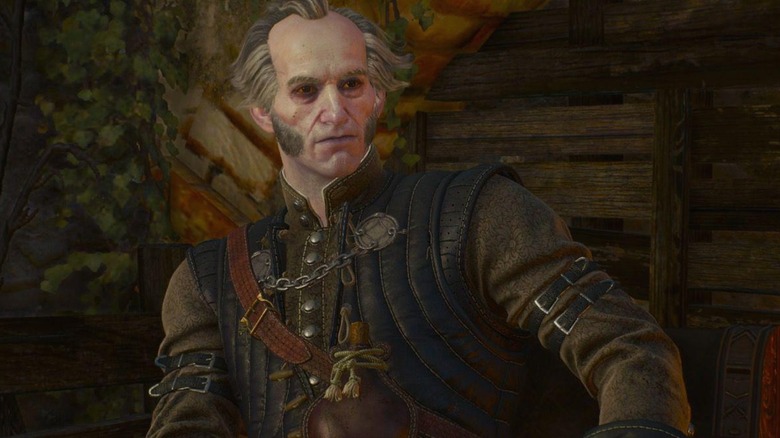
Sapkowski easily makes us believe that a steadfast monster slayer like Geralt chooses not to kill Regis even after learning of his vampirism. Indeed, Geralt meets Regis at a time when he is emotionally unstable due to Ciri’s disappearance, and when the superior vampire’s wise advice proves crucial to the witcher’s growth as a character. This is also the case in the Netflix adaptation; Geralt finds a dear friend in Regis, who helps him manage his emotions.
As for “The Witcher 3”, the game’s timeline does not feature Regis as he is presumed dead in the books. That said, Regis makes a surprise return in the game’s “Blood and Wine” DLC, which is a nice addition to the character’s story.
The DLC opens with Geralt on vacation in Touissant, where he intends to retire soon. But trouble arises once Regis arrives on the scene looking for the vampire Dettlaff, who is on a vicious killing spree. After Geralt is hired to kill the beast, Regis intervenes, begging him not to do it. You see, it was Dettlaff who resurrected Regis after his death, and Regis wants to understand Dettlaff’s motivations before making a rash judgment. What follows is a thrilling game of cat and mouse, filled with clues, false leads and complex choices, in which Geralt must trust his old friend, the vampire he desperately wants to protect.
“Blood and Wine” understands why Regis is such a beloved character. He breaks all stereotypes associated with higher vampires, while willingly adopting noble and altruistic tendencies. There’s a side to these beliefs that’s completely absent from Fishburne’s version, which feels like another ally to Geralt down the road.


