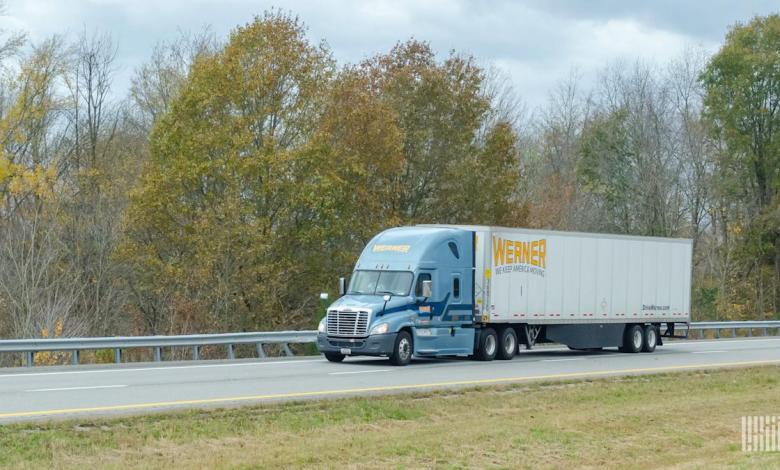
Werner Enterprises CEO Derek Leathers told analysts on Thursday that ongoing enforcement measures and capacity exits could pave the way for a “more balanced” freight market by 2026.
On Thursday, the Omaha-based truckload carrier (NASDAQ: WERN) posted a third-quarter loss of $20.6 million amid challenging freight and legal settlement costs.
“We are entering peak season with healthy consumer demand and strong retail alignment,” Leathers said. “Multi-pronged enforcement actions are leading to continued declines in capacity, and pricing noise appears to be taking hold. Ongoing structural improvements in our costs, combined with recent productivity gains, put us on a better footing to take advantage of upside as the market becomes more balanced.
Leathers noted that enforcement action against non-domiciled drivers and B-1 visa drivers could remove a significant number of operators from the market.
“If the appetite for enforcement persists, and I think we all agree that it does, there will be capacity leaving this market – and it will be more significant than what we’ve seen so far,” Leathers said.
He added that even if some marginalized drivers returned in response to tighter supply and rising rates, that “would pale in comparison” to the number of expected exits due to new compliance crackdowns and CDL enforcement.
Leathers emphasized that technological automation and AI remain at the heart of Werner’s cost reduction strategy.
“In logistics, automation is almost completely implemented,” Leathers said. “We’re automating everything we can to remove friction from the process – and that’s reflected in our operating expenses. »
He said these systems allow Werner to increase volume without proportionally increasing operating costs, while in truckload services (TTS), digital conversion is still underway.
“Until you can completely unplug and convert, it represents a near-term headwind,” Leathers said, adding that AI is now being deployed in recruiting, billing and collections to “do more with less.”
Leathers said the company’s dedicated pipeline remains strong, with most new fleet launches postponed until early 2026.
“Our dedicated implementations will be true dedicated fleets – hard to maintain and defensible type, not just volume masquerading as dedicated,” Leathers said. “It’s a pain to implement, but once you’re on the other side, the retention value is worth it.”


