The Star Wars design for Chewbacca combined real animals with a creature from another sci-fi classic


While one can cite many reasons for the cultural success of “Star Wars” (John Williams’ iconic score, for example, or the compelling blend of science fiction and Arthurian myth), aesthetics must be at the very top of the list. From Colin Cantwell’s incredible spaceship designs to Ralph McQuarrie’s early concept art for planets, lightsabers and characters like Luke Skywalker and Darth Vader, the look and feel of 1977’s “Star Wars: Episode IV – A New Hope” helped shape the unique universe from the start.
Eventually, however, these initial designs had to be farmed out to modelers, prop makers, and other practical effects artists. This includes creatives like makeup artist Stuart Freeborn, who worked with George Lucas to create Chewbacca’s practical look. A veteran of the film industry dating back to the 1940s, Freeborn gained particularly relevant experience working on Stanley Kubrick’s “2001: A Space Odyssey,” a film that gave him the exact know-how needed to create the very first Chewbacca costume for Peter Mayhew.
“I used pretty much the same principle as with the 2001 Apes for Chewbacca,” Freeborn told Starlog Magazine in a 1986 interview, “the only difference being the exterior. Instead of a monkey face, Chewbacca has a different type of face, and hairy rather than a monkey’s. Otherwise, it was Exactly the same thing inside.
George Lucas’s own pets influenced Chewbacca’s design
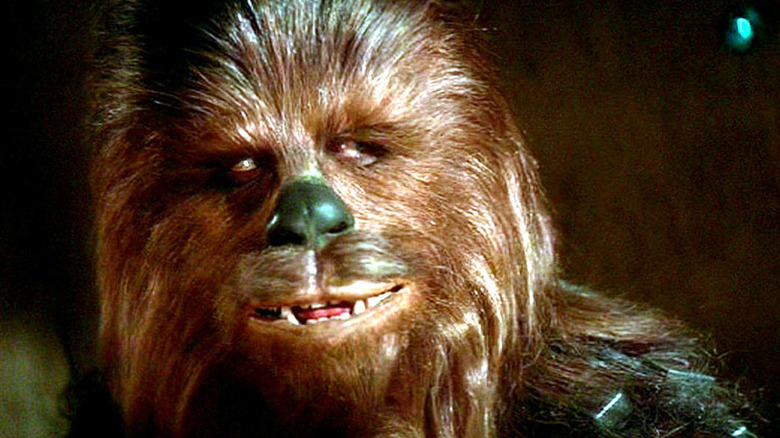
While Freeborn’s ape experiment from “2001” helped him create the basics of Chewbacca’s costume, Lucas had something specific in mind for the character’s face.
“George mentioned that he had a dog and a cat, stating that he had imagined the Wookie [sic] like a dog,” Freeborn told Starlog in 1986. Straying from that basic tone and his previous work on “2001,” the makeup artist created a basic sculpture to demonstrate what he had in mind. While Lucas initially approved of the look, he later returned with a new angle.
“He had studied his cat and concluded that Chewie must be a feline creature,” Freeborn said. “I tried a feline version but he still wasn’t convinced. ‘Couldn’t you try combining the two?’ he asked me.” This final idea, mixing the cat and dog faces with the furry alien body, ended up being the winner, giving rise to the Wookiee design that fans know and love today.
As additional Lucas trivia, some fans may already know that the dog in question – an Alaskan Malamute named Indiana – inspired two different franchises. While lending his image to Chewbacca, he gave his name to the protagonist of the “Indiana Jones” films.
Chewbacca’s original design has barely changed in decades
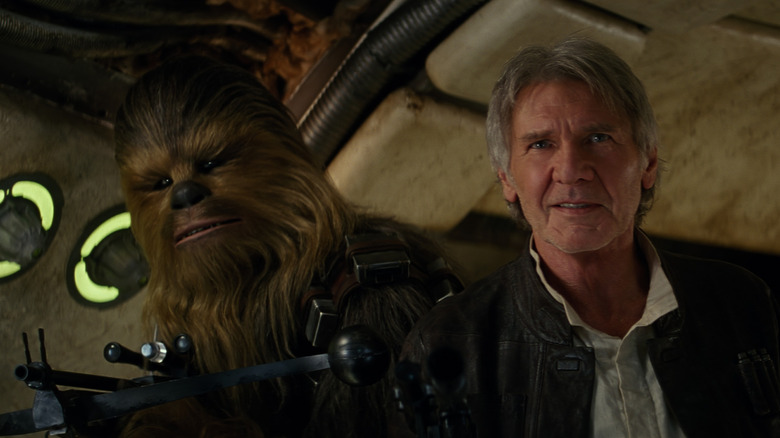
McQuarrie’s original art for the character who would become Chewbacca – initially designed as Han Solo, then an alien – was significantly altered before the character appeared on screen (although this first pass later inspired the character Zeb in “Star Wars Rebels”). However, once Freeborn got to work and came up with the final Chewbacca costume, things were set. After decades of “Star Wars” films and two additional trilogies, as well as the spinoff film “Solo: A Star Wars Story,” which featured the hairy guy, this original design has barely changed.
“They’re basically built the same way as the original Chewie,” creature supervisor Dave Elsey said in a report on the making of “Star Wars: Episode II – Revenge of the Sith.” In this film, many more Wookiee costumes had to be made for the massive battle between the furry aliens and the Separatist droid army on the Wookiee home planet of Kashyyyk. Mayhew reprized the role of Chewbacca for the character’s brief appearance in the prequel era, donning a costume very similar to that of his original trilogy.
When it came time to bring Chewie back once again for “Star Wars: Episode VII – The Force Awakens,” the design once again remained consistent. In another making-of featurette for this film, supervising animatronics designer Maria Cork said the team’s goal was to “keep things simple” and “completely copy” the original design. Mayhew commented that although the design was essentially the same, it was “better” and “lighter”, probably thanks to several decades of advancements in prosthetics and makeup for films. Despite this, the 70s version of Freeborn remains timeless.


