
This article contains spoilers for “28 Years Later: The Temple of Bones.”
When Sir Lord Jimmy Crystal (Jack O’Connell) and his band of demented “Jimmys” appeared in the bonkers ending of “28 Years Later,” there was a heavy implication that poor young Spike (Alfie Williams) had just gone from the frying pan to the fire. Of course, neither he nor we had much to say about the extent of Jimmy’s depravity. They sure seemed to be nomadic, violent raiders in a post-apocalyptic landscape, but we’ve seen dozens of such groups in many zombie movies as well as films like “Mad Max.” Initially, the biggest clue to the gang’s psychology was how they took inspiration from former British media personality and sex pest Jimmy Savile. So while they were certainly immoral, it wasn’t clear from Danny Boyle’s film how low they could stoop.
“28 Years Later: The Temple of Bones” by Nia DaCosta answers this question and more. In fact, this happens in the first scene, as Spike is forced to undergo the Jimmy initiation ritual of choosing another member (called the “finger” of Jimmy’s “fist”) to fight to the death in order to take their place. This is only the tip of the iceberg in terms of brutality, however, as we are shown the full extent of the JImmy’s “charity” when the gang attacks a group of people sheltering on an isolated farm. This extended sequence involves the Jimmys torturing and killing most of their victims by skinning them alive, which is a level of gore that even fans of the series may not be prepared for. It’s a brilliantly effective and necessary scene, one that serves the film in multiple ways.
The bloody sequence fully establishes Crystal and Jimmy’s characters
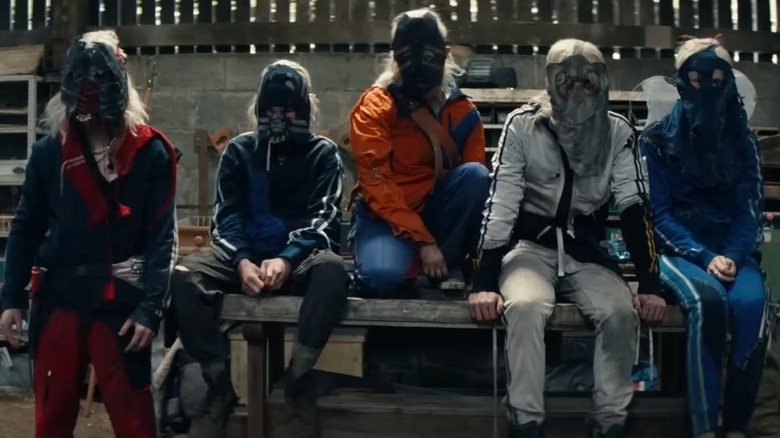
In the film, Jimmy Crystal and his gang overpowered the farm family and hanged four of them. Although Crystal has made hints and references to being a Satanist before the scene, it is here that the ritualistic nature of his gang comes into view, as he gives a little devilish sermon before explaining to the victims that his fingers will perform an act of “charity” on them, which must be something called “taking off the shirt”. This means that the Fingers start skinning the others alive, except for one, Tom (Louis Ashbourne Serkis), who is offered the chance to become a Finger by choosing Jimmima (Emma Laird) to fight to the death.
Although Nia DaCosta doesn’t linger on the count alive, her camera doesn’t turn away from it either. What’s more disturbing is seeing flayed bodies that are still technically alive but dying hanging in the background of moments where other characters interact, thus making the violence jarringly banal. In this way, DaCosta and writer Alex Garland describe Crystal and Jimmy’s MO, both literally and figuratively. Being the son of a fire and brimstone vicar, Crystal’s religious upbringing has congealed to the point where he sees himself as the literal Antichrist, the son of the Devil aka Old Nick. He believes that the outbreak of the Rage Virus is proof that Hell has come to Earth, and so it is his mission to raise his fist and commit acts of atrocity out of devotion to his dark lord. The removal of the shirt sequence resembles British horror films like “Hellraiser” as well as newer French Extremity films like “Martyrs,” both of which feature characters being flayed alive for reasons beyond simple pain.
DaCosta and Garland use the scene to maintain the series’ thematic coherence
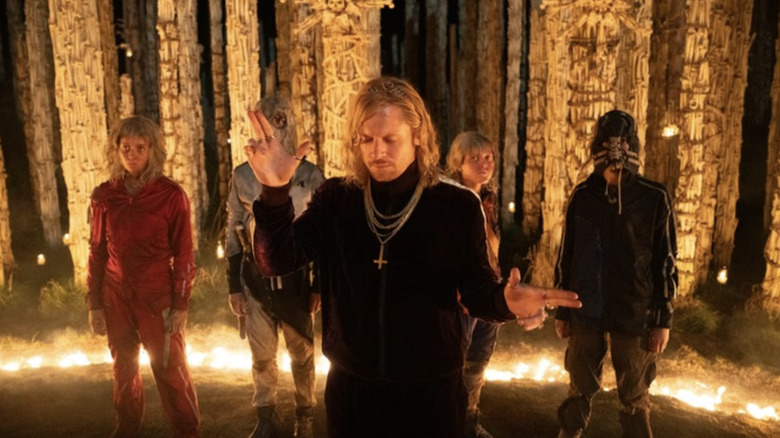
In addition to people who are generally put off by the extreme gore of the sequence, there are perhaps some who find it too much, even for a zombie film. In this case, it is important to reiterate that “The Bone Temple” and the entire “…Later” series are not technically a zombie franchise. The virus was never about reanimating the dead, but rather about causing human beings to succumb to an infection that causes uncontrollable rage. The opening scene of “28 Days Later” shows that the virus came from chimpanzees placed in a perpetually agitated and aggressive state, and implies that this state was partially created by the chimpanzees being forced to view images of humans acting in various inhumane ways for hours on end. Thus, the virus could be considered Evil itself; a biological representative of Man’s worst impulses.
One of the most fascinating aspects of “The Bone Temple” involves Dr. Ian Kelson (Ralph Fiennes) attempting to study and cure the virus via his infected guinea pig, Samson (Chi Lewis-Parry). Although this allows Garland to further specify the nature of the infection in the film’s text, the “shirt removal” sequence allows it to be clarified within the film’s subtext. Garland and DaCosta demonstrate how broken and toxic people like Crystal and her Jimmys have brought humanity to this current moment, just as Kelson and Samson give us some hope to transcend our baser natures. In the same way that Evil disguises itself as Good (using terms like “charity”) and Good masquerades as Evil (Kelson’s pantomime as Old Nick), “The Bone Temple” is ultimately a very moral humanist film wearing a macabre disguise.
“28 Years Later: The Temple of Bones” is in cinemas around the world.


