
Sofia VolianovaBBC News Russian
 Married
Molecule, a pill promising rapid weight loss, went viral on Russian TikTok earlier this year.
Young people’s feeds began to be filled with captions such as “Take one molecule and forget that food exists” and “Do you want to sit at the back of the class in oversized clothes?” »
Clips showed refrigerators lined with blue boxes featuring holograms and “Molecule Plus” labels.
Orders began to pile up, as teens shared their “weight loss journeys” on social media.
But there was a catch.
Maria, 22, had purchased the pill from a popular online retailer. She took two tablets a day and, after two weeks, said her mouth was dry and she had completely lost her appetite.
“I had absolutely no desire to eat, let alone drink. I was nervous. I was constantly biting my lips and chewing my cheeks.”
Maria developed severe anxiety and began having negative thoughts. “These pills had a profound effect on my psyche,” she says.
Maria, who lives in St. Petersburg, says she was not prepared for such serious side effects.
Other TikTok users reported dilated pupils, tremors and insomnia. And at least three schoolchildren were reportedly hospitalized.

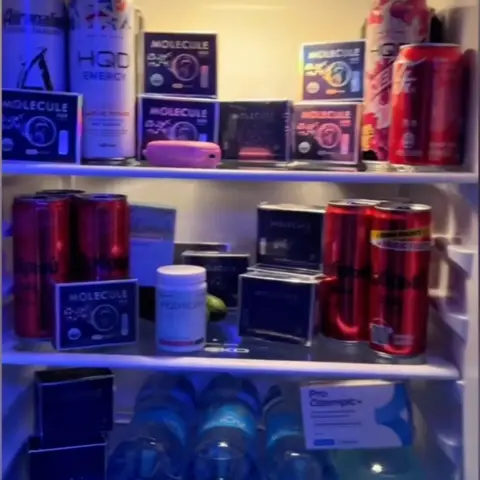 TikTok
In April, a schoolgirl from Chita, Siberia, had to be hospitalized after overdosing on Molecule. According to local reports, she was trying to lose weight quickly, in time for summer.
The mother of another schoolgirl told local media that her daughter was admitted to intensive care after taking several tablets at once.
And in May, a 13-year-old boy from St. Petersburg had to be hospitalized after experiencing hallucinations and panic attacks. He allegedly asked a friend to buy him the pill because he was teased at school about his weight.
Substance banned in UK, EU and US
Molecule pill packaging often lists “natural ingredients” such as dandelion root and fennel seed extract.
But earlier this year, journalists from the Russian newspaper Izvestia tested pills they had purchased online and found they contained a substance called sibutramine.
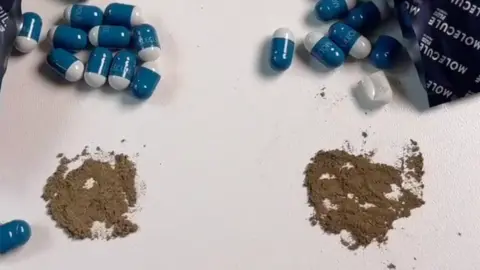 TikTok
First used as an antidepressant in the 1980s and later as an appetite suppressant, studies found that sibutramine increased the risk of heart attacks and strokes, while only slightly promoting weight loss.
It was banned in the United States in 2010 and is also illegal in the United Kingdom, European Union, China and other countries.
In Russia it is still used to treat obesity, but available only for adults and by prescription.
Buying and selling sibutramine without a prescription is a criminal offense. But that hasn’t stopped individuals and small businesses from selling it online – often in higher doses than legal drugs – and without a prescription.
Unlicensed pills cost around £6 to £7 ($8 to $9) for a 20-day supply – much cheaper than recognized weight loss injections like Ozempic, which on the Russian market sell for between £40 and £160 ($50 to $210) per monthly pen.
“Self-administration of this drug is very dangerous,” says endocrinologist Ksenia Solovieva from St. Petersburg, warning of the potential risks of overdose, “because we do not know how much active ingredient these ‘food supplements’ may contain.”
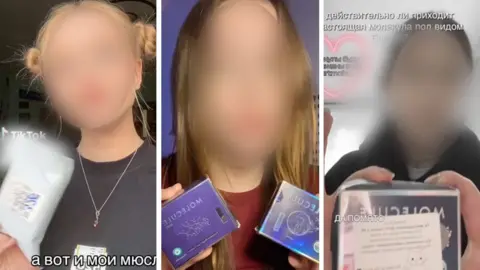 TikTok
Russians are routinely sentenced to prison for buying and reselling Molecule pills. But it is proving difficult for authorities to control drugs sold illegally.
In April, the government-backed Safe Internet League reported the growing trend involving young people to authorities, prompting several major online marketplaces to remove Molecule from sale. But it soon began appearing online under a new name, Atom, in almost identical packaging.
A law was recently passed allowing authorities to block websites selling “unregistered dietary supplements” without a court order – but sellers have gotten around this by classifying them as “sports nutrition” instead.
On TikTok, you can find retailers selling Molecule under listings that appear to be for muesli, cookies, and even light bulbs. And some retailers don’t even try to hide it anymore.
A few weeks ago, the BBC found lists of molecules on a popular Russian online marketplace. When contacted for comment, the site said it quickly removed all products containing sibutramine. But he admitted it was difficult to find and remove listings that did not explicitly mention sibutramine.
If you do manage to get your hands on Molecule, it’s hard to know exactly what you’re getting – and it’s unclear where exactly the pills are made.
The BBC found sellers with production certificates from factories in Guangzhou and Henan, China. Others claim to source their pills from Germany.
Some packages say they were produced in Remagen in Germany – but the BBC found no such company is listed at the address given.
Some Kazakh sellers selling Molecule to Russians told the BBC they bought stock from friends or warehouses in the capital Astana, but could not name the original supplier.
- Details of eating disorder support in the UK are available at BBC action line
Meanwhile, online eating disorder communities have become spaces where Molecule is promoted, with users relying on hashtags and coded terms to escape moderation.
Ms Solovieva says Molecule is particularly harmful when taken by young people already suffering from eating disorders. For those who are relapsing or about to relapse, a readily available appetite suppressant can be very dangerous, she says.
Anna Enina, a Russian influencer with millions of followers who herself admitted to using diet pills without permission in the past, publicly warned her followers: “As someone who has struggled with an eating disorder… the consequences will be disastrous. You will regret it ten times over.”
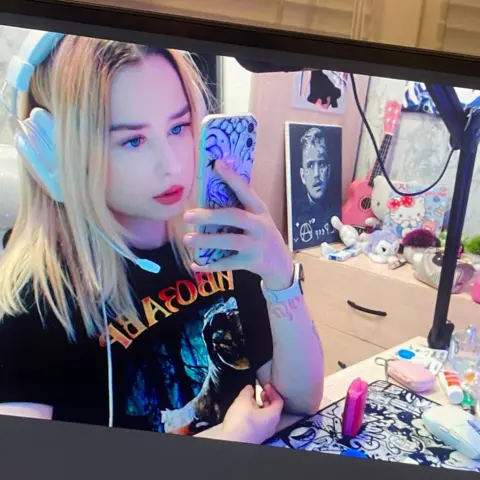
Maria, 22, suffered serious side effects and is one of those who regrets it. After taking too many Molecule pills, she was sent to the hospital.
Now she discourages other young women and girls from taking the pills on weight loss forums. She even contacted the parents of a teenage user to alert them.
But Molecule remains popular online.
And every video that appears on Maria’s TikTok feed is a reminder of the pills that made her sick.


