
This article contains discussions about mental health and mass violence.
There’s been a lot of debate, lately, about the state of masculinity in our troubled times (if I may, I highly recommend reading Jessica Winter’s New Yorker essay on the subject). It turns out that Noah Wyle — the Emmy Award-winning star and executive producer of HBO’s hit medical series “The Pitt” — has his own goals when it comes to helping young men navigate increasingly tricky territory, and he did it through a storyline about, among other things, a mass shooting.
In Season 1 of “The Pitt,” Wyle’s Dr. Michael “Robby” Robinavitch meets a young man named David Saunders (Jackson Kelly), whose mother Theresa (Joanna Going), is calling in sick so she can go to the emergency room and report her son for keeping a list of women he plans to potentially target. When a mass shooting occurs later in the season, David is a natural suspect… but Robby treats him more gently than his colleagues. According to Wyle, it was a distinct choice, especially because Robby goes through his own emotional journey during the season.
“It’s really interesting for me to talk about what I was trying to do with Robby in a sense, which was at least display a different form of masculinity on television,” Wyle told Esquire, explaining Robby’s surprising approach and his own broader mission to represent the broad spectrum of masculinity. “He’s a good, heroic, complex guy. He’s not perfect. He has character. He has unresolved pain. Ultimately, he has to realize that compartmentalizing his feelings and repressing them is no healthier than it was for David. There has to be a path of release and a safe community for conversation and healing to take place.”
The fact that no one listens to David is what leads him down a dangerous path in The Pitt.
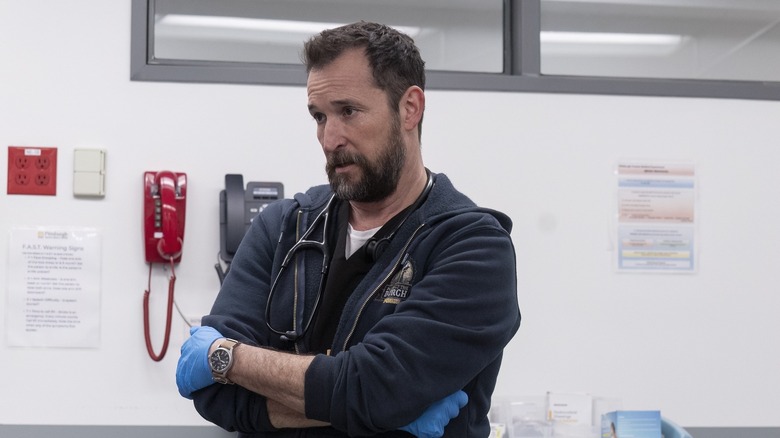
I don’t want to mince words here, and neither does Noah Wyle, but it still needs to be said: Even though we find out that David isn’t the shooter, it’s deeply reprehensible and downright scary that he’s made a list of young women he wants to potentially harm. Wyle, elsewhere in this interview, explained that while David’s feeling “misunderstood” is not an excuse, perhaps it is an explanation.
“David feels neither seen nor heard, and he falls through the cracks. It triggers all sorts of paranoia and feelings of judgment and bias,” Wyle mused, particularly when talking about Dr. Robby’s colleague, Dr. Cassie McKay (Fiona Dourif), taking a much harsher approach towards the young man. In reality, it is a prudent behavior that needs to be addressed. It speaks to the very interesting place we live in, where there’s a problem and I’m not sure I know what the right remedy is.”
Wyle also said that although David’s anger seems apparent, he believes it is actually sadness. “Deep down, most people are heartbroken and don’t know how to express it. And so we’re all trying to get attention the way we do,” Wyle said. “Sometimes it’s positive, sometimes it’s negative, but it’s definitely about attention, and you’re definitely going to be seen and you’re going to be heard in one way or another. That’s what’s at the root of the problem – everyone just wanted to be recognized. But man, it can take some pretty heinous consequences if you ignore it.”
Noah Wyle is concerned about the way men express themselves in modern times, and he hopes his work on The Pitt can help
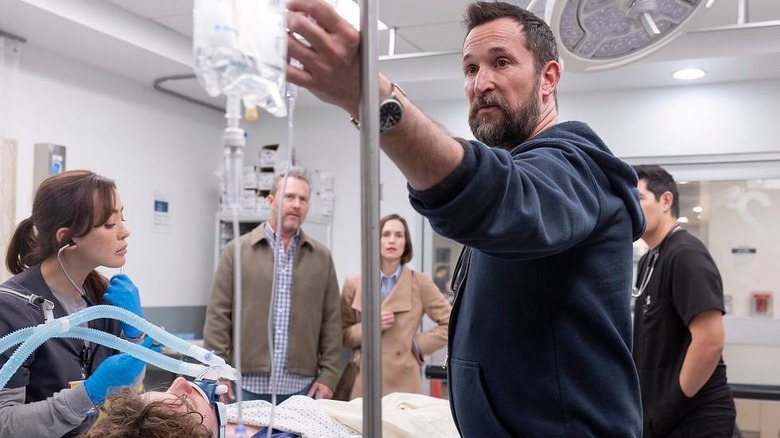
I completely agree with Noah Wyle’s point of view here, and I think what he is trying to do by showing Dr. Robby’s “version” of masculinity in “The Pitt” is not only noble; it is necessary. Speaking about raising a son in his 20s, Wyle said: “I just think there were so many other ways for young men to do these kinds of things: to improve their courage and their manhood and to test themselves and each other. And if they didn’t do that, they weren’t punished as harshly for their mistakes.”
To be clear, Wyle isn’t making excuses for behavior like David’s. He nevertheless stressed the importance of supporting young men sufficiently so that they do not embark on a similar path. After stating that everyone should have opportunities, Wyle concluded: “We are all fallible. We are all trying to figure this out together. We should have a little grace as we grow. Seeing everything in such a binary way all the time has really become problematic for our world. By necessity, we have to appreciate complexity.”
So, what happens to David in “The Pitt?” His mother signs an order for him to get desperately needed help for his own mental health, and although David seems angry, he eventually breaks down in tears, struck by the magnitude of what he has done and the healing journey that lies ahead. In just 15 episodes, “The Pitt” presents several visions of modern masculinity, and when it comes to Dr. Robby’s gentler, kinder approach to manhood, he sets, to Wyle’s credit, an example that many nonfictional men could follow.
If you or someone you know needs help with mental health, please contact Crisis Text Line by texting HOME to 741741, call him National Alliance on Mental Illness hotline at 1-800-950-NAMI (6264), or visit National Institute of Mental Health website.
If you have been affected by incidents of mass violence or are experiencing emotional distress related to incidents of mass violence, you can call or text. Disaster Hotline at 1-800-985-5990 for assistance.


