
As temperatures drop, Lahore ranked Monday morning as the world’s most polluted major city, with air quality dropping to “very unhealthy” levels, according to Swiss monitor IQAir.
At around 8 a.m., the city’s AQI⁺ was 297, while PM2.5 concentrations reached 222.5 micrograms per cubic meter, about 44.5 times the World Health Organization’s annual guideline value.
These fine particles, small enough to penetrate deep into the lungs and enter the bloodstream, pose serious health risks, especially to children, the elderly and people with respiratory illnesses.
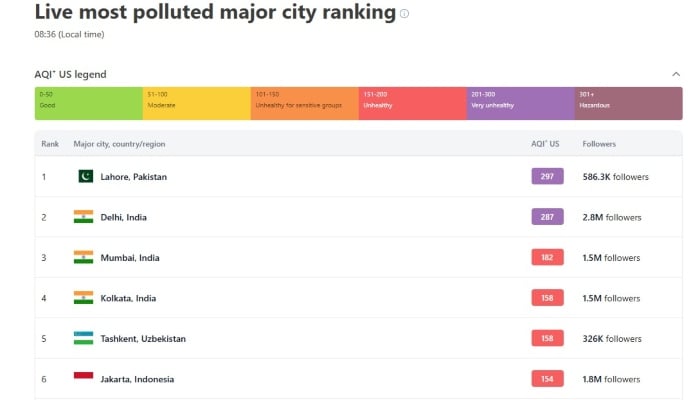
Lahore was followed by New Delhi (287), Mumbai (182) on the global pollution table. Other cities in the top 10 include Kolkata (158), Tashkent (158), Jakarta (154), Dhaka (152) and Dubai (152), with three Indian cities in the top five.
On Sunday, the city’s average AQI was recorded at 160, classified as “unhealthy.”
According to IQAir data, PM2.5 was the dominant pollutant, measuring 13.7 times the WHO annual guideline value. Environmentalists said the persistence of PM2.5 pollution indicated that civic agencies such as the Lahore Development Authority (LDA) and the Metropolitan Corporation Lahore (MCL) were failing to implement anti-smog standard operating procedures during ongoing development and construction projects.
They urged Chief Minister Maryam Nawaz to order an immediate halt to large-scale infrastructure and construction activities across Punjab – particularly in Lahore and other major cities – warning that without intervention, “the situation will continue to worsen”.
Meanwhile, Punjab Chief Minister Marriyum Aurangzeb said that on the instructions of the chief minister, nine provincial departments had launched a “major operation” to combat smog. She said the combined efforts of government departments and public cooperation had brought the AQI of Lahore “under control”.
Aurangzeb said environmental protection teams were on the ground, brick kilns were monitored by drones and live reports were published daily. She said smog guns and air quality monitors were deployed and, for the first time, a coordinated whole-of-government strategy monitored AQI levels as predicted.
She added that a modern weather data center identifies areas of high pollution in advance, enabling targeted action in “smog hotspots”. Departments were instructed to cover construction materials, while traffic police were instructed to restrict heavy vehicles during the day. Agencies including WASA, LDA, PHA, C&W and the Ministry of Agriculture had launched spraying and control operations, including a crackdown on stubble burning across Punjab.
The megalopolis has remained a fixture in global pollution rankings, frequently ranking among the most contaminated urban centers in the world. Air quality in Lahore typically deteriorates during the winter season, from October to February, when farmers in Punjab province set fire to leftover crops, producing smoke that adds to smog. At the same time, climate change means pollutants remain trapped in the air for longer.
Air pollution in Lahore is caused by a combination of vehicle and industrial emissions, smoke from brick kilns, burning of crop residues and general waste, and dust from construction sites. Other drivers of air pollution include large-scale loss of trees for the construction of new roads and buildings.
Air pollution in winter is worse because of the temperature inversion, which results in a layer of warm air that cannot rise and trap air pollutants.
Last year, IQAir recorded a spike in pollution in Lahore with a hazardous AQI of 1,110 on November 14, when PM2.5 levels reached 632 micrograms per cubic meter of air, prompting authorities to declare a province-wide health emergency. Schools were closed, universities moved classes online and a construction ban was imposed to ease the crisis.
Last year, however, the smog season started earlier than usual and intensified more severely. Experts have warned that the concentration of PM2.5 particles has already exceeded dangerous thresholds, representing one of the highest values in five years.


