
Miguel Angel Villegas Escobar says more than a dozen people have been killed in his region, which remains cut off from the rest of Mexico’s Hidalgo state, after torrential rains, overflowing rivers and mud washed away the area’s bridges and roads.
Villegas Escobar, regional director of primary education in the village of Chahuaco in the landlocked state of Hidalgo, said via WhatsApp voice messages that entire families in the region had been swept away by widespread flooding caused by rains that fell over four days last week in five Gulf Coast and central states.
He said he knew of 15 people in the municipality of Tianguistengo – which includes several villages like Chahuaco – who were killed in the floods and buried under mud.
Two people are still missing in the nearby village of Tlacolula, which is also part of Tianguistengo and was hardest hit, Villegas Escobar said. The majority of homes in the village were destroyed, he said in voice messages from Chahuaco, located about 250 kilometers northeast of Mexico City.
Villegas Escobar said Chahuaco residents used ancient trails, packing supplies on pack animals and horses to bring aid to Tlacolula residents. “We went there to help,” he said.
Dozens dead, thousands of houses damaged
The storms left 64 dead and 65 missing, according to data released Monday by Mexican authorities during a press conference.
Heavy rains fell between October 6 and 9, causing rivers, ravines, and ditches to overflow, cutting power, triggering landslides, and washing away highways and roads in the states of Veracruz, Hidalgo, Puebla, Querétaro, and San Luis Potosi.
“The federal government, state governments and municipalities have been present to help the affected populations,” said Laura Velázquez, national coordinator of the federal civil protection agency, who revealed the figures at the press conference.
🔴 The Chiquito River changed its course in Chapultepec de Huauchinango, Puebla.
The waters swept away a house, a tree and waste, causing further overflows.pic.twitter.com/Fa47ucIO72
The states of Veracruz, Hidalgo and Puebla were hardest hit by the devastation, leaving 56 people dead and more than 100 communities affected, according to government figures.
Images circulating on social media and local media showed streets transformed into rivers of water and mud, people gathered on house roofs and roads washed away by landslides. Local media reported that at least one police officer drowned while trying to rescue the victims.
The administration of Mexican President Claudia Sheinbaum and the governors of the three main affected states, all of whom are part of the ruling National Regeneration Movement (Morena) party, have been criticized by opposition politicians and the public for what is seen as a slow response and failure to issue warnings or preemptive evacuations, according to local media.
On Monday morning, a group of residents staged a silent protest in front of the National Palace in Mexico City’s historic center, holding signs asking the president to help residents of Texcatepec, Veracruz, according to a report from CMX Noticias.
Sheinbaum said at the news conference that preliminary government figures showed more than 100,000 homes were damaged or destroyed by the rains.
She said an airlift, with helicopters, was now helping about 60 communities in Veracruz, Hidalgo and Puebla that were stranded due to collapsed roads and highways. Some of these communities have a small population of around 1,000 people, Sheinbaum said.
“First we open the federal highways…then we entered the [highways]”, she said. “From the beginning, we determined that it was the most urgent to get to these places.”

Sheinbaum said she felt the frustration of residents reeling from the devastation caused by the heavy rains.
The president faced questions about a video emerged on Sunday showing frustrated citizens in Poza Rica, Veracruz, confronting her as she walked through the devastated area, claiming that several university students were missing.
“I personally got out of the vehicle to listen to people, and they told us they need more help, more equipment…and support for families,” Sheinbaum said at the news conference.
“I explained to them that more help was coming, … that no family would be left defenseless.”
Authorities monitored Pacific Coast systems
The force of the rains seemed to surprise the authorities.
Raymundo Pedro Morales Ángeles, Secretary of the Navy, said early last week that authorities were monitoring a potential tropical cyclone called Raymond and a hurricane called Priscilla that were developing off the country’s Pacific coast.
But at the same time, a low pressure system, which formed in the Gulf of Mexico off Veracruz on October 8, ended up colliding with a cold front coming from Texas and caused a sudden burst of rain, Morales Ángeles said.

The rainy season in the region was coming to an end, rivers and water tables were at their limit and slopes were already weakened by previous rains, creating conditions for massive flooding, Morales Ángeles said.
“There was no scientific, meteorological condition that could have told us that the rains would be of this magnitude,” Sheinbaum said.
The municipality of Tianguistengo has been classified as a priority area by the Mexican government.
Villegas Escobar said the army had made contact with the area with two helicopters and was beginning work to rebuild roads and bridges.
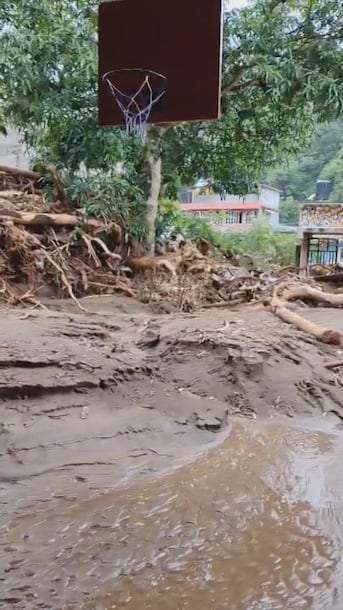
Miguel Angel Villegas Escobar, regional director of primary education in the village of Chahuaco, describes the destruction of the school in the village of Tlacolula.
In a video shared with CBC News, Villegas Escobar called on the governor of Hidalgo, Julio Ramón Menchaca Salazar, local deputies and senators to come to the aid of Tuscolula.
In the video, he shows the village’s primary school, which is nothing more than a mangled wreck of mud, bricks and tree trunks, in a scene reminiscent of the aftermath of a tsunami.
“People need a lot of help here in Tlacolula,” he said.


