
Israeli warplanes launched strikes on Gaza on Tuesday, killing at least 26 people, after Israel accused the militant group Hamas of violating a ceasefire in the Palestinian territory, the latest test of a fragile deal negotiated earlier this month by US President Donald Trump.
Local health authorities said the deaths included five people in an affected house in the Bureij refugee camp in the central Gaza Strip, four in a building in the Sabra neighborhood of Gaza City and five in a car in Khan Younis, including two children, according to Ahmed al-Farra, head of the pediatrics department at Nasser Hospital, where the bodies were taken.
Attacks by Israeli planes continued early Wednesday in the Gaza Strip, according to witnesses.
Witnesses also reported strikes in Gaza City. Mohamed El Saife, a freelance CBC videographer in Gaza, also heard the fighter jets in the Gaza City area.
A statement released earlier by Netanyahu’s office did not specify the reason for the planned attacks. However, an Israeli military official said the militant group violated the ceasefire by carrying out an attack on Israeli forces in an area under Israeli control.
“This is another blatant violation of the ceasefire,” the official said.
Israel notified the United States before launching the strikes, according to two U.S. officials who spoke to The Associated Press on condition of anonymity.
Israeli media earlier reported an exchange of fire between Israeli forces and Hamas fighters in the southern Gaza town of Rafah, but Hamas denied responsibility for the attack on Israeli forces. The Israeli military did not respond to a request for comment on this information.
Aboard Air Force One bound for South Korea, U.S. President Donald Trump said Wednesday morning that the U.S.-backed ceasefire is not under threat.
“Nothing will jeopardize” the ceasefire, Trump said.
Netanyahu previously accused Hamas of violating the weeks-old agreement by handing over erroneous remains as part of the process of handing over hostage bodies to Israel.

Hamas initially said in response that it would hand over to Israel on Tuesday the body of a missing hostage found in a Gaza tunnel. However, Hamas’ military wing, the Al-Qassam Brigades, later said it would postpone the planned handover, citing what it sees as ceasefire violations by Israel.
Hamas said it was respecting the terms of the ceasefire and Netanyahu was looking for excuses to evade Israel’s obligations.
Each side accused the other of violations.
As part of the ceasefire in the two-year-old war, Hamas released all living hostages in exchange for nearly 2,000 Palestinian prisoners and detainees of war, while Israel withdrew its troops and halted its offensive.
Hamas also agreed to hand over the remains of all dead hostages who have not yet been recovered, but said it would take time to locate and recover the bodies. Israel says the militant group can access the remains of most of the hostages.
The remains belonged to the body found in 2023
This issue has become one of the main sticking points in the ceasefire, which Trump says he is following closely.
Netanyahu said the human remains handed over Monday belonged to Ofir Tzarfati, an Israeli killed in the Oct. 7, 2023, Hamas-led attack that precipitated the war, whose body was found by Israeli forces in the first weeks of the fighting.
The Israeli military said Hamas men placed Tzarfati’s remains at a dig site before calling in a Red Cross team and claiming to have found a missing hostage, in order to create a “false impression of efforts to find the bodies.”

A 14-minute video released by the army shows three men placing a white bag on a dig site and then covering it with dirt and stones. Reuters was unable to verify the Israeli version of what the video shows. Hamas and the Red Cross did not immediately respond to a request for comment.
Earlier, a Hamas spokesman said finding all the bodies was a challenge due to the scale of destruction in Gaza and the lack of equipment needed to recover them.
Nonetheless, “Hamas will continue to make every possible effort to hand over the remaining bodies until this issue is fully resolved and as soon as possible,” Hazem Qassem told Reuters.
Israeli Finance Minister Bezalel Smotrich and National Security Minister Itamar Ben-Gvir both called on Netanyahu to take tough action against Hamas.
However, any response will likely first need to receive the green light from Washington, which earlier this month negotiated the fragile ceasefire that ended two years of war, a senior Israeli official said.
Two Israeli security sources said the bodies of only three hostages are currently beyond Hamas’ reach.
Bulldozers authorized to intervene to help search efforts
The search for the bodies of the hostages has accelerated in recent days since the arrival of heavy equipment from Egypt. Bulldozers were working Tuesday in Khan Younis in the southern Gaza Strip and further north in Nuseirat, while masked Hamas fighters were deployed around them.
Some of the bodies are believed to be in the Hamas tunnel network that runs beneath Gaza.
Across the enclave, rescuers are searching through rubble for the remains of thousands of Palestinians still missing after two years of Israeli strikes that destroyed most of the enclave.
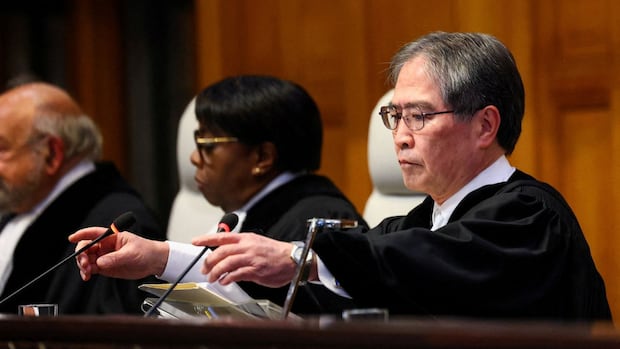
The International Court of Justice has issued an advisory opinion saying Israel must allow the United Nations humanitarian agency in Gaza, known as UNRWA, to provide humanitarian aid to the war-torn territory.
Gaza health authorities say 68,000 people have been killed in Israeli strikes and thousands more are missing. Israel launched the war after Hamas-led fighters stormed southern Israel, killing 1,200 people and taking 251 hostages back to Gaza.
The sounds of explosions can still be heard in Gaza, as Israeli forces continue demolitions in areas where they remain deployed.
Israeli Defense Minister Israel Katz said Saturday that troops would continue to demolish Hamas tunnels, 60 percent of which were still intact.


