As Vance arrives to strengthen the ceasefire in Gaza, how committed are Hamas and Netanyahu to peace?


Vice President JD Vance, along with President Trump’s negotiating team – his son-in-law Jared Kushner and US special envoy Steve Witkoff – were all in Israel on Tuesday trying to consolidate the fragile ceasefire in Gaza. Before leaving for Israel, Vance said bumps in the path to peace were expected.
“There are going to be fits and starts,” Vance told reporters. “Hamas will shoot at Israel, Israel will of course have to react.”
Hamas has denied responsibility for an alleged RPG attack that killed two Israeli soldiers over the weekend. Israeli Prime Minister Benjamin Netanyahu said Monday that it was a Hamas attack and that the Israeli military responded to the alleged ceasefire violation by dropping nearly 169 tons of bombs on Gaza.
“One of our hands holds a weapon, the other is outstretched for peace,” Netanyahu told lawmakers on Monday. “You make peace with the strong, not the weak. Today, Israel is stronger than ever.”
Israeli strikes have killed at least 45 Palestinians, according to health officials in the Hamas-run territory.
President Trump on Monday warned Hamas against breaking the agreement that took months to negotiate.
“They’re going to behave, they’re going to be nice,” he said. “And if they’re not, we’re going to eradicate them if we have to.”
Kushner and Witkoff met with Netanyahu on Monday, and the Israeli leader’s office said Vance would also meet with him this week. Vice President and Second Lady Usha Vance were greeted upon their arrival Tuesday by U.S. Ambassador to Israel Mike Huckabee, Israeli Ambassador to the United States Yechiel Leiter and Israeli Justice Minister Yariv Levin.
Nathan Howard/Pool/Getty
Vance was scheduled to have a working lunch with Witkoff and Kushner on Tuesday before his meeting with Netanyahu.
The peace process progressed gradually despite the weekend’s violence, with Israel returning the remains of 15 Palestinians to Gaza on Tuesday after Hamas handed over the body of another deceased hostage on Monday evening. As part of the peace deal, a total of 165 Palestinian bodies were returned to Gaza, many of them former detainees, while the 20 living Israeli hostages were released by Hamas, along with the remains of 13 deceased captives.
But despite these measures, the long-term viability of Mr. Trump’s peace plan, which he says will end nearly eight decades of fighting between Israel and the Palestinians, remains uncertain.
Former Israeli official questions prospects of Trump peace plan
Some Israelis remain skeptical about the Israeli prime minister’s real interest in lasting peace. Among them is Netanyahu’s fierce critic Alon Pinkas, who served as an adviser to four Israeli foreign ministers.
He told CBS News that Netanyahu signed the peace deal negotiated by Mr. Trump, but never really supported its main goal, nor Mr. Trump’s stated goal of securing lasting peace in the heart of the Middle East.
“This is a deal he was bullied into,” Pinkas said. “It’s a deal he signed under duress, and now he’s developing a new plan to manipulate Trump.”
Pinkas credited Mr. Trump for making “something his predecessors were reluctant or hesitant to do, namely exert real pressure” on the Israeli leader.
“It worked, but it only worked in the first phase,” Pinkas said, referring to the freed live Israeli hostages and the ceasefire coming into force.
He said after the weekend’s violence that the deal had been “apparently restored, but when Netanyahu says, ‘I’m restoring the ceasefire,’ it’s only because there is a visit here by the vice president, JD Vance, and because the United States sent its envoy.”
Pinkas said he was certain that Israeli forces would resume operations in Gaza within days, stressing that they remained deployed in about half of the Palestinian territory.
Amir Cohen/Reuters 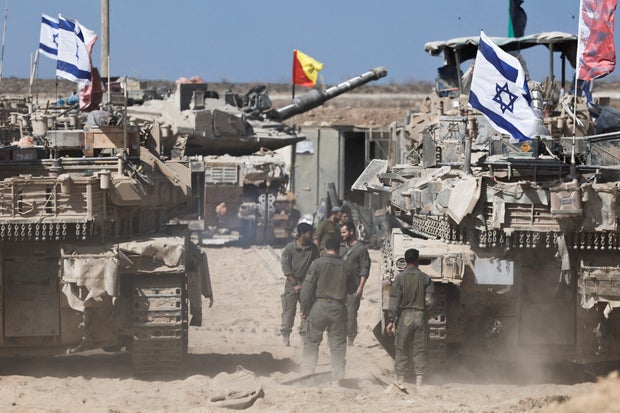
“The hostages are no longer in danger because they have been released and Hamas has not been decisively destroyed, as Mr. Netanyahu had promised and touted for two years. So I see a serious incentive for Mr. Netanyahu to resume” an offensive against Hamas, Pinkas told CBS News. “Maybe not on a large scale, given the deal, but I see… a local skirmish turning into a broader outbreak, which then deteriorates or escalates into a full-fledged Israeli military operation.”
Hamas’ top negotiator said Tuesday that the group remained committed to the ceasefire agreement. But President Trump’s peace plan calls for the demilitarization of Gaza, and many analysts, including Pinkas, doubt that Hamas will voluntarily hand over all its weapons.
“This is probably the biggest flaw in the deal,” Pinkas said. “The agreement itself is a good agreement, but for such an agreement to work it requires good faith, goodwill and trust. None of these ingredients exist. In fact, both sides have a vested interest in not going beyond the ceasefire.”
“Hamas wants to lure Israel inside [Gaza] in a de facto occupation, mount an insurrection and show the Palestinians that they are the real resistance. And Netanyahu wants to go because he knows that if everything stops now and there is progress towards the next phases, it almost inevitably means that he will be seen as the one who failed to defeat Hamas. »
Pinkas said that although the past two years of war have left Hamas militarily defeated and degraded, “Hamas is not finished. Hamas is here, and you see these images every day. You show them on CBS – Hamas gangs walking around in combat gear, armed. That’s not going to solve the problem politically for Mr. Netanyahu.”
Dawoud Abou Alkas/Reuters 
Speaking in a recent interview with CBS News’ Tony DokoupilNetanyahu said his government had agreed “to give peace a chance,” but he noted that the conditions of Mr. Trump’s 20-point peace plan “are very clear: It’s not just about getting the hostages out without withdrawing our military, but also about then achieving both demilitarization and disarmament.” It’s not the same thing. First, Hamas must surrender its weapons. arms smuggling into Gaza.”
“We also agreed: Okay, let’s finish the first part. Now let’s give a chance to do the second part peacefully, which is my hope,” the Israeli leader told CBS News.


