
John Wayne’s firm, cowboy drawl is easily imitated, as exemplified by Robin Williams, Phil Hartman and many others. Peter Cullen’s voice as Optimus Prime in “The Transformers” is sometimes also compared to Wayne’s (although Cullen cites a different inspiration).
One of Wayne’s less famous impressions came as Sandy Becker, a radio announcer and early television talk show host turned voice actress, in the 1960s Western comedy “Go Go Gophers.” Set in the circa 1870s, during the westward expansion of the United States, the series is a parody look at the U.S. Army’s attempt to drive Native Americans from their lands. Contrary to reality, the horsemen still cannot make the natives leave.
Leading this cavalry are two anthropomorphic coyotes: Colonel Kit Coyote (Kenny Delmar) and Sgt. Okey Homa (Becker). The two have often been described as caricatures of President Theodore “Teddy” Roosevelt and John Wayne, respectively, and you can see it in their character designs. Roosevelt was a true American hero of that era, and Wayne retroactively became one by appearing in numerous Hollywood westerns. The coyotes are not the heroes of this series, however. It’s the two remaining “Gopher Indians”, Running Board (George S. Irving) and Ruffled Feather (Becker), who always manage to outwit the coyotes (often with the help of their anachronistic inventions).
“Go Go Gophers” ran for 48 five-minute episodes, produced as segments of the Superman parody cartoon “Underdog.” Although obscure today, the “Underdog” family of cartoons was released on DVD in the 2000s, which caught my young eye after the 2007 live-action film “Underdog” first introduced me to the series. I caught the slapstick of “Go Go Gophers” (it’s hard not to) but I didn’t have the cultural context of the kids watching the show in the ’60s. By that time, Westerns had been the dominant entertainment in Hollywood for decades, propagating the stereotypes of the Old West that this cartoon both used and satirized.
Go Go Gophers has aged well and hasn’t aged well
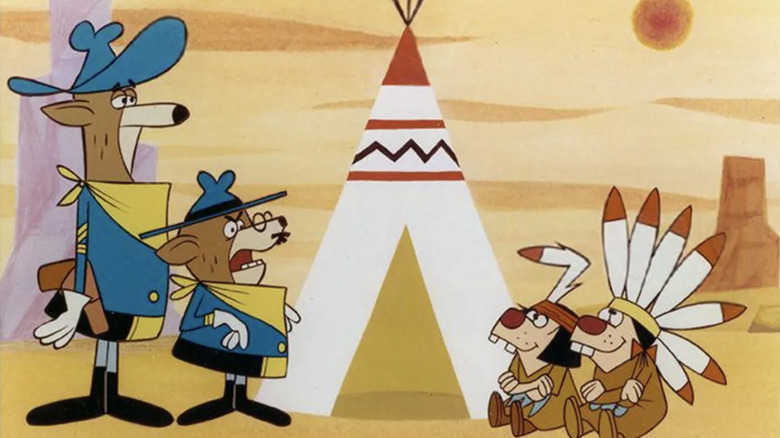
Sixty years later, “Go Go Gophers” is definitely not politically correct by today’s standards. The very fact that Gophers are called “Indians” and not “Native Americans” reflects this. They are based more on the stereotypical Native people from Western films, not reality, just like the caricatures of caricatures.
Running Board speaks in broken English and Ruffled Feather speaks only in gibberish, apparently his native language. This marks them both as “other” and “uncivilized”, although it belies that they are both quite intelligent. The machine is not spectacular either; the animation is rather cheap and simplistic, in the manner of contemporary Hanna-Barbera cartoons, and the plot is repetitive.
Retrospective reviews of “Go Go Gophers” are mixed. Some attack stereotypes and/or criticize turning historic crimes committed against indigenous people into farces. However, the indigenous characters are not the ones treated as the most eccentric. In American westerns, the cowboys have always been the good guys and the natives the bad guys. Even more nuanced films, like Wayne’s “The Searchers,” still often portrayed natives as savage raiders whom white settlers should fear. “Go Go Gophers” understood that it was the natives who were under siege in the first place and who were trying to protect said settlers from having their land taken.
Go Go Gophers satirized Western films and Manifest Destiny
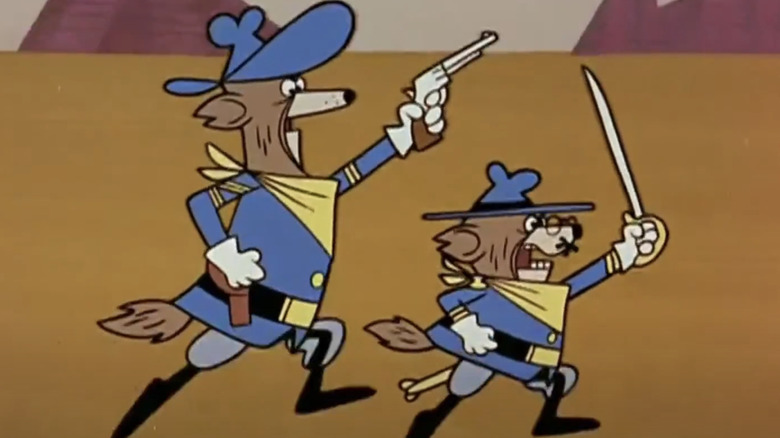
In “Go Go Gophers,” the natives are amusing pranksters against heavy-handed authority, and they are those who always win. Conversely, the colonel is gullible and pompous. The sergeant is calmer and more friendly but always accompanies his boss. The couple ends most episodes in a daze after receiving a dynamite blast to the face.
It is for these reasons that “Go Go Gophers” has also been called subversive and progressive for its time. Part of the satire concerns the fact that the program parodied the buffoonish Colonel and the hapless Sergeant. Teddy Roosevelt was an avowed imperialist who sadly declared: “I don’t go so far as to think that the only good Indian is the dead Indian, but I believe that nine out of ten are, and I wouldn’t want to investigate too closely the case of the tenth.” »
John Wayne not only starred in numerous films promoting Manifest Destiny and the Lost Cause of the Confederacy, he was also a staunch right-wing advocate in real life. At the 1973 Academy Awards, Marlon Brando refused his best actor award for “The Godfather” to protest Hollywood’s demonization of Native Americans; he asked Indigenous activist Sacheen Littlefeather to attend the ceremony and decline in his place. A rumor eventually spread that Wayne, who was in the crowd, had to be stopped from attacking Littlefeather, but this could very well be a myth.
In “Go Go Gophers,” Roosevelt and Wayne’s replacements are introduced, episode after episode, by the people they denigrated in life.


