Leonard Nimoy’s feud with Gene Roddenberry killed a major Star Trek anniversary project


We may receive a commission on purchases made from links.
In 1991, the year “Star Trek” celebrated its 25th anniversary, the franchise was booming. The hit series “Star Trek: The Next Generation” wrapped up its fantastic fourth season, and Nicholas Meyer’s feature film “Star Trek VI: The Undiscovered Country” hit theaters in December. Plans were afoot for other, larger “Star Trek” projects, including a new television series, and the anniversary year was to be marked by the release of an endless amount of merchandise. This anniversary was unfortunately marked by sadness since the creator of the franchise, Gene Roddenberry, died in October at the age of 70.
Roddenberry, an optimist and survivor (literally of a plane crash), will always be appreciated for creating “Star Trek,” a pop sci-fi series that, improbable as it may seem, espoused a progressive philosophy of peace and diplomacy. Roddenberry’s vision was utopian, and “Star Trek” became one of the modern world’s most definitive texts about a hopeful future. This is where Gene Roddenberry left us, contemplating our potential.
In person, however, Roddenberry was not always diplomatic. Indeed, he frequently wrested control of his “Star Trek” projects from others, cheated people out of their salaries, and preached free love a little too much; he loved seeing the female cast members of “Star Trek” in those 1960s miniskirts. He was also proud of himself, happy to hear people (like me) praising his noble ideas.
This self-aggrandizement led to a strained relationship with Spock actor Leonard Nimoy. Indeed, in Susan Sackett’s 2002 book “Inside Trek: My Secret Life with Star Trek Creator Gene Roddenberry,” it was explained that Nimoy put the kibosh on a 25th anniversary “Star Trek” coffee table book for two reasons. Firstly, he disliked the crude commercialization of the book’s language, but also because he refused to feed on the Roddenberry myth.
Leonard Nimoy forced Gene Roddenberry to cancel a 25th anniversary coffee table book
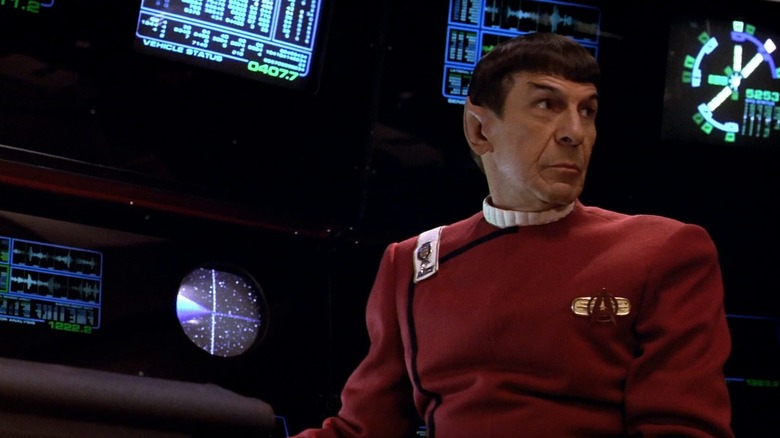
Sackett, it should be noted, was a longtime producer and writer on “Star Trek,” as well as Gene Roddenberry’s personal assistant. Many Trekkies will be quick to add that Sackett was also Roddenberry’s girlfriend, a scandalous detail, since their relationship paralleled his marriage to Majel Barrett. Sackett was involved enough with “Star Trek” to propose writing a 20th anniversary coffee table book in 1986. Unfortunately, this project never came to fruition due to various legal delays, so it eventually turned into a 25th anniversary book, which was to be published in 1991.
It was a huge book, priced at $45.00, and it was to contain in-depth interviews with everyone from “Star Trek” and “Star Trek: The Next Generation”, as well as a host of new illustrations by artist Richard Arnold.
But the book was never published and Leonard Nimoy is directly responsible for it. According to Sackett’s book, Nimoy was one of the last actors to sign the photos of Spock that were to be used in the book, and only then did he begin reading the text. Nimoy disapproved of the text, apparently, an objection stemming from a closed-door meeting between Nimoy, Nimoy’s attorney Roddenberry, and Roddenberry’s attorney Leonard Maizlish. It appears that the book was too commercially coded for Nimoy, and that he would have preferred more pretentious language that emphasized the cultural importance of “Star Trek.” As Sackett wrote:
“The book was shelved because Leonard Nimoy didn’t think the prose was ‘noble enough,’ as Maizlish put it, and wanted it more in the style of someone like Bill Moyers.”
Moyers was the co-author of the valuable 1988 tome “The Power of Myth,” alongside Joseph Campbell.
Leonard Nimoy had contractual approval of any Star Trek project using his image
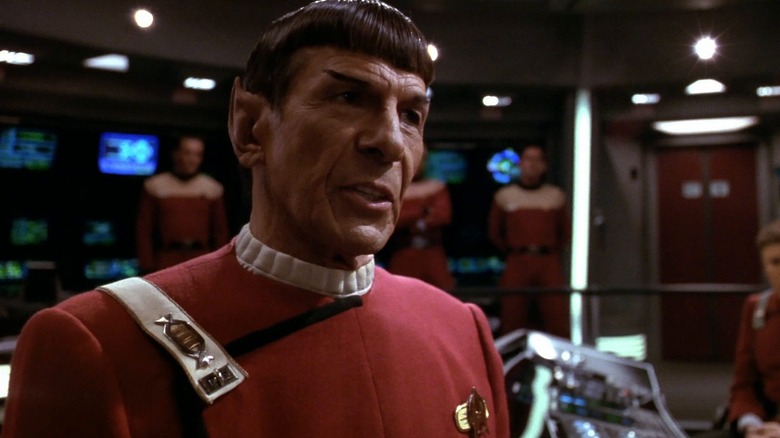
Nimoy, the book also points out, did not get along very well with Roddenberry in 1991, adding much animosity to the closed-door meeting above. Sackett once heard a Desilu executive say that Nimoy hated Roddenberry for his self-aggrandizing habits and that he didn’t like the credit Roddenberry took for himself. Nimoy refused to sign the text of the 25th anniversary book, something that was included in his contract, and he single-handedly forced the book to be shelved. Much of the manuscript was eventually reused for a 1994 book titled “Star Trek: Where No One Has Gone Before – A History in Pictures.” Sackett’s name does not appear on the cover of this book.
Nimoy’s cancellation of the book was well known to fans thanks to a 1992 article in “Cinefantastique” magazine. This issue simply explained that Nimoy had vetoed the book because it had not been consulted, and that Pocket Books had put it on hold indefinitely. He also explained that the unpublished book contained numerous quotes from Roddenberry, all highlighted with bold text, and almost no quotes from the actors or other creators who worked on the series. Nimoy’s contract allowed him to endorse any “Star Trek” ancillary product that bore his likeness, so he had 100 percent legal right to end the project.
In 1996, there was a wave of 30th anniversary writings, and new writings and derivative products emerge every five years. In 2026, “Star Trek” will celebrate its 60th anniversary and will undoubtedly inspire other books and magazines. The celebration will never stop.


