
Please note: this article contains major spoilers for episodes 1 and 2 of “Pluribus”.
What is “Pluribus” supposed to be? We’re not referring to the literal title, which is explained pretty quickly in the first half of the premiere. Instead, the Apple TV series from “Breaking Bad” and “Better Call Saul” visionary Vince Gilligan has always had something else up its sleeve. Before release, marketing saw fit to keep the actual premise almost completely secret. All we know is that the story follows Rhea Seehorn’s Carol Sturka as, apparently, “the most miserable person on Earth” and very little else. Vaguely disturbing and perhaps apocalyptic images in the small teasers have hinted at something bigger, not to mention the fan theories running rampant and ranging from zombies to alien invasions and everything in between.
The truth, as it happens, might as well be the best of both worlds. The first episode, titled “We Is Us” and written/directed by Gilligan, knowingly plays into the extraterrestrial angle by opening with astronomers working on Project SETI (Search for Extraterrestrial Intelligence) or a SETI-like organization. This is further amplified upon the discovery of a strange signal of unknown origin, which fully kicks off the events of the series. But when things inevitably go wrong when – as they so often do – two scientists engage in a little too casual animal experiments, the next genre Gilligan looks into seems to be a potential viral outbreak. When This doesn’t exactly turn out to be the case, the next logical assumption is that it’s secretly a zombie tale.
However, the ultimate hive mind twist takes all of these classic sci-fi tropes and remixes them into the most unexpected of them all.
Pluribus subverts our expectations of science fiction every step of the way

Leave it to Vince Gilligan to upend all our assumptions and make “Pluribus” the rarest spectacle these days – one that actually keeps us guessing from one moment to the next. Although recent water-cooler breakthroughs like “Severance” or “Succession” have yielded very similar results from week to week, the majority of our biggest streaming options these days have been based on material whose overall destination we know: the prequel series “Andor,” or the live-action adaptation of “The Last of Us,” or even the recent “It: Welcome to Derry.” (It’s worth noting that Gilligan turned arguably one of the scariest prequel ideas in recent memory, “Better Call Saul,” into a sensation that could even rival that of “Breaking Bad.”)
So, right on cue, here comes “Pluribus” which takes the attributes of the most famous science fiction stories and blends them into something that feels totally fresh and original. Yes, Gilligan wears inspirations like “Invasion of the Body Snatchers” or “The Twilight Zone” on his sleeve, but art is all about taking the familiar and turning it into something new. As we follow Carol down this increasingly nightmarish rabbit hole, where the individuality that once defined the human race has been replaced in a hostile takeover by an unbearably kind consciousness, the true horror of this scenario comes to light. What is freedom in a world without a true sense of free will? What makes us human if we no longer bother to fight for what we think is right? What’s so wrong with accepting the inevitable instead of stubbornly opposing the new status quo?
These are the uncomfortable questions that “Pluribus” asks us in a way few other series could.
Pluribus achieves what zombie or alien invasion shows simply can’t do
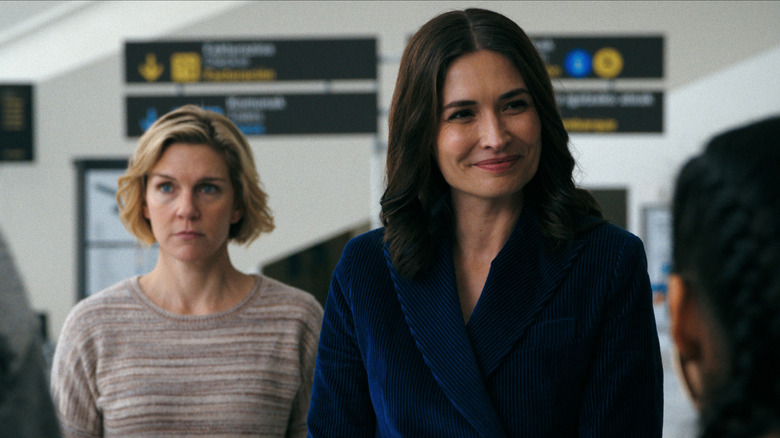
Even though creator Vince Gilligan insists that “Pluribus” only ultimately became a science fiction story by chance, it’s easy to see why he chose to depict the events of the series through this genre lens. Granted, Gilligan’s options for explaining such a supernatural phenomenon were obviously rather limited. Still, he could have easily explained this through a number of sci-fi shenanigans. Instead, it landed very specifically on the idea of a hive mind triggered by a virus sent to us (most likely) by aliens that essentially turns 99% of the population into mindless zombies – a fun approach that reflects the series’ major thematic idea of taking the many and turning them into one.
The end result is that “Pluribus” does what countless other series simply couldn’t do. Even though “The Walking Dead” held 2010s audiences in a chokehold, the genre’s inherent limitations meant it could only really support one source of drama, over and over again: What if humans were, like, the real Undead, dude? Even “Prestige TV” shows like “The Last of Us” can’t completely escape this same notion. Netflix’s “3 Body Problem,” a show we’ve long championed, operates with one arm tied behind its back as it constructs its own version of alien invasions.
“Pluribus,” meanwhile, is free to take the best aspects of post-apocalyptic media and elevate the rest. Unlike zombies or aliens, Carol’s “enemy” does not wish to harm her. The gang of survivors here don’t even like our main hero. And we wonder if the end of the world is Really so bad, after all. New episodes air on Apple TV every Friday.


![Most maligned Freddy Krueger film predicts modern horror [Exclusive]](https://i3.wp.com/www.slashfilm.com/img/gallery/the-most-maligned-freddy-krueger-movie-predicted-modern-horror-exclusive/l-intro-1759923866.jpg?w=390&resize=390,220&ssl=1 "Most maligned Freddy Krueger film predicts modern horror [Exclusive]")
