China launches Shenzhou 21 mission, carrying 3 taikonauts – and 4 mice – to replace space station crew


Jiuquan Satellite Launch Center — China launched its Shenzhou-21 spacecraft on Friday, carrying a new three-person crew to pilot China’s Tiangong space station in a mission focused on scientific research. The replacement crew includes China’s youngest taikonaut – as China’s space program calls its astronauts – and, for the first time since Beijing launched its program, it will also include live mammals.
The Shenzhou-21 and its crew lifted off from the Jiuquan Satellite Launch Center in northwest China atop a Long March-2F rocket just before midnight Friday, around 11 a.m. Eastern Time.
The taikonauts on board – Zhang Lu, Wu Fei and Zhang Hongzhang – will rotate so that the trio currently aboard China’s space station on the Shenzhou-20 mission, launched on April 24, can return home after their six months in space. The exact date of their return has not yet been announced.
Maxim Shemetov/Reuters
The Shenzhou-21 crew is expected to conduct a total of 27 scientific and applied research projects during its mission, focusing on several fields including space life sciences, biotechnology, space medicine, space materials science, physics and fluid combustion in microgravity, and new space technologies, according to information provided by the China Manned Space Mission Agency (CMSA).
Alongside the taikonauts, Shenzhou-21 carries four mice – two females and two males – the first living mammals ever carried by China into space. Two previous missions to Tiangong Station transported live fish.
The taikonauts will study the effects of microgravity and confined space conditions on the behavior of mice.
The Shenzhou-21 crew, with Lu as commander, is expected to live aboard the space station for about six months, as will the crew they are replacing.
Maxim Shemetov/Reuters 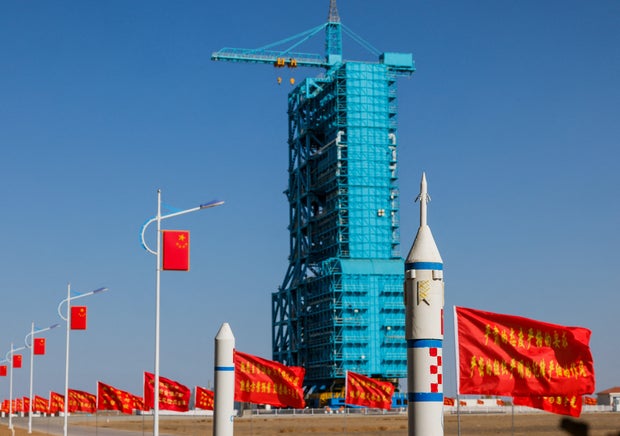
This will not be the first visit to the station for Lu, who previously participated in the Shenzhou-15 mission.
The other two crew members are making their first space flight and flight engineer Wu, born in 1993, will be the youngest taikonaut ever sent into space by his country.
“I feel extremely lucky,” he told reporters Thursday. “Being able to integrate my personal dreams into the glorious journey of China’s space program is the greatest good fortune this era has bestowed on me.”
Crowds gathered around the Jiuquan launch site Friday before the countdown, and a man who identified himself to CBS News only as Mr. Zhao said he was “very excited” to be there with his 7-year-old son, “hoping to plant the seed of a space dream in his heart.”
China’s growing ‘space dream’
China has unilaterally ramped up its space program since its exclusion from the International Space Station project – largely due to US government concerns over the Chinese military’s complete control over its program – to achieve its “space dream” under President Xi Jinping.
It has occupied Tiangong Station since 2021, and is now scheduled to bring the first non-Chinese crew member aboard the facility.
China will arrange for a Pakistani national to undertake a short-term space mission in the future, the CMSA announced, following the signing of a cooperation agreement between the two countries in February.
China Aerospace Science and Technology Society 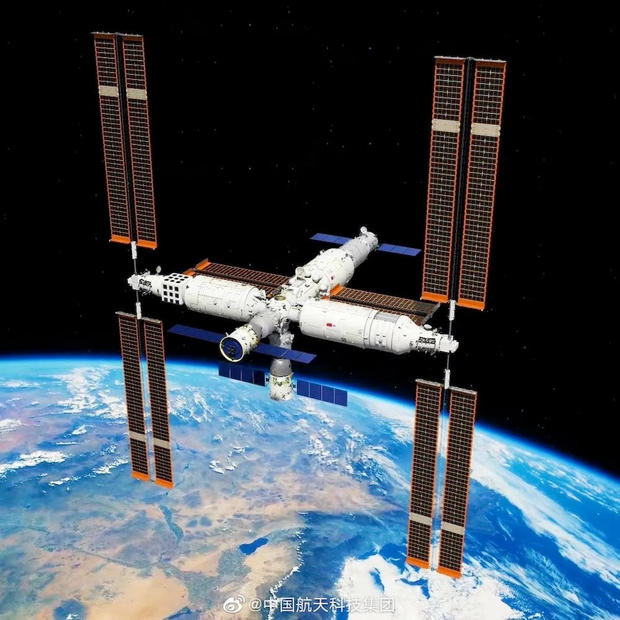
The process of selecting a Pakistani national for training has already begun, along with planning of training programs and preparation of logistical support for the envisaged Pakistanis.
Following the selection process, two Pakistani nationals will travel to China to train alongside Chinese taikonauts for future missions, the CMSA said.
CMSA spokesperson Zhang Jingbo said at a news conference this week ahead of Shenzhou-21’s launch that China would welcome international partners to participate in missions aboard its space station.
Work on China’s space station coincides with and often complements the country’s efforts to become the first country to land a person on the surface of the Moon in more than 40 years. Chinese authorities have set a public goal of landing taikonauts on the surface of the Moon by 2030 and, ultimately, building a lunar base.
China has already placed unmanned probes on the Moon, including the first to land and collect samples from the hidden side of the celestial body just last year.
“Overall, research and construction have gone smoothly, with China aiming to achieve the goal of sending Chinese astronauts to the Moon before 2030,” Zhang said this week ahead of Shenzhou’s impending launch, indicating that the CMSA remains on track to achieve its lunar goals.


